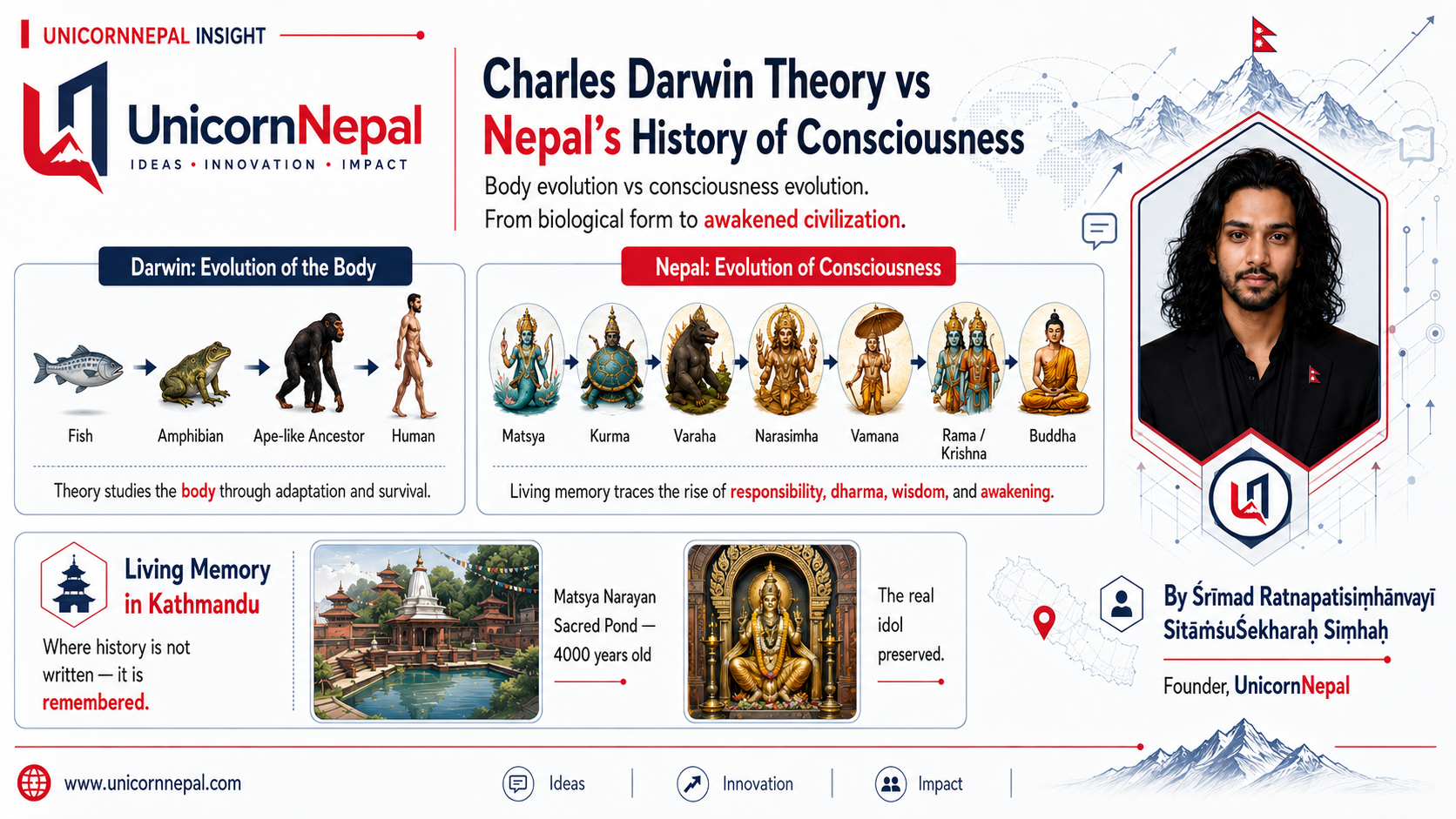
The modern world often speaks of human evolution through Charles Darwin.
Darwin gave the world a powerful theory: life began in simpler biological forms, adapted through nature, struggled for survival, and slowly changed across time. In that framework, the human being is understood through the body; bone, blood, species, mutation, environment, survival, and biological inheritance.
Darwin’s evolution is the journey of the organism.
Nepal’s evolution history is the journey of consciousness.#
That is Nepal's royal inheritance: more than 2,000 years of uninterrupted civilization, preserving its identity through the rise and fall of empires.
Darwin asks:How did the human body evolve from earlier life forms?Nepal asks:How did life become worthy of being called human?
Darwin looks at the body and sees adaptation. Nepal looks at the human being and sees responsibility.
Darwin follows the movement from water to land, from animal to primate, from instinct to intelligence. Nepal remembers another movement: from survival to protection, from protection to duty, from duty to sacrifice, from sacrifice to wisdom, from wisdom to liberation.
One is biological evolution. The other is civilizational evolution.#
One studies the human as a species. The other remembers the human as a bearer of dharma.
This is where the comparison becomes majestic.
Darwin’s theory begins with aquatic life. The avatāra tradition begins with Matsya.
Darwin sees life rising from water. Nepal remembers divine consciousness appearing first through water.
Darwin’s imagination moves from fish toward amphibian and land life.#
The avatāra sequence moves from Matsya to Kurma , from fish to tortoise, from water to the first foundation.
Darwin sees the emergence of land animals. The avatāra sequence remembers Varaha, the boar who lifts the earth itself from drowning.
Darwin sees the long animal-human threshold. The avatāra sequence remembers Narasimha, half animal, half human, the terrifying border between instinct and moral force.
Darwin sees the emergence of early man. The avatāra sequence remembers Vamana — the small human form, physically humble, but cosmically intelligent.
Darwin sees human force, struggle, dominance, and survival. The avatāra sequence remembers Parashurama, the weapon-bearing human who must confront corrupted power.
Darwin sees organized human society. The avatāra sequence remembers Rama, moral kingship, law, duty, restraint, and the burden of dharma.
Darwin sees intelligence as a biological advantage.
The avatāra sequence remembers Krishna, complete intelligence, strategy, music, love, war, diplomacy, cosmic vision, and the divine voice of the Gita.#
Darwin’s theory reaches the human as a developed organism. Nepal’s sacred memory moves further, toward Buddha, awakening, compassion, renunciation, and the conquest of suffering.
This is not a small parallel.
It is one of the most profound comparisons in human thought.
Darwin gives a ladder of biological form. The avatāra tradition gives a ladder of consciousness.
Darwin says life adapts. The avatāra story says consciousness descends, protects, corrects, teaches, and awakens.
Darwin follows species. The avatāra follows dharma.
Darwin explains the body’s ascent. The avatāra explains civilization’s ascent.
Darwin may tell us how the human animal emerged. The avatāra tradition asks whether that human animal became noble enough to be called human.
Nepal does not need to oppose Darwin. Nepal completes the question Darwin leaves unfinished. Biology may explain the body. It cannot fully explain sacrifice, dharma, sacred duty, moral courage, liberation, and the human hunger for truth. It may explain survival, but it cannot explain why survival must become meaningful.
Nepal’s answer begins with Matsya.
Matsya is the first avatāra. Not a king, not a warrior, not a philosopher, not a monk — a fish. The first divine descent appears in aquatic form, before the full emergence of human civilization. This is not a decorative mythological detail. It is the most powerful symbolic beginning.
The first stage of life is water. The first stage of consciousness is protection.#
In Darwin’s view, life survives because it adapts. In Nepal’s sacred memory, life becomes human when it learns to protect. Manu does not become great because he conquers. He becomes worthy because he protects the small fish before knowing it is divine.
That is the beginning of Nepal’s evolution history.
The human being becomes human not merely by standing upright, using tools, speaking language, or organizing society. The human being becomes human when he recognizes responsibility toward life.
Darwin’s theory may explain the rise of the human body. Matsya explains the rise of human conscience.
Before civilization can become philosophical, it must survive. Before it can become royal, it must preserve. Before it can become ethical, it must protect. Before it can become enlightened, it must remember.
Matsya is the memory of the world before human civilization became fully conscious of itself. It is the story of the flood, the ark, the seed, the warning, and the preservation of life. But at its deepest level, it is the first story of moral recognition.
A small fish asks for protection. Manu responds.
That response is the first step from animal instinct to human dharma.
So the contrast with Darwin is not that Nepal rejects evolution. Nepal carries a deeper version of it. Darwin speaks of the evolution of form. Nepal speaks of the evolution of meaning. Darwin traces the body’s struggle for survival. Nepal traces consciousness becoming worthy of survival.
The West may say: life came from water.
Nepal says: yes, and from water came the first lesson of responsibility.
This is why Matsya Narayan of Machhegaun of Kritipur, Kathmandu, matters.#
Matsya Narayan is not simply a local temple. It is a living witness of this older memory. During Malamas, also known as Purushottam Maas or Adhik Maas, when many ordinary auspicious rituals are avoided across Sanātana practice, Matsya Narayan becomes alive with devotion. When ordinary time pauses, the first avatāra returns to the center. When the calendar becomes irregular, the memory before civilization awakens again.
Matsya belongs to flood-time. Malamas belongs to extra-time. Both appear when cosmic rhythm becomes unusual. Both ask the same question: what must be preserved when time itself becomes unstable?
Nepal answers through living memory.
That is why Nepal’s sacred history cannot be reduced to one printed book, one colonial archive, one foreign theory, or one academic footnote. Nepal carries memory through multiple layers:
Śāstra - textual source.
Sthala-purāṇa - sacred-site narrative.
Paramparā - transmitted memory.
Ācāra - lived practice.
Tīrtha continuity - uninterrupted worship and pilgrimage.
Deśa-smṛti - regional sacred memory.
When these six layers live together, civilization does not beg for validation. It speaks through continuity.#
Kathmandu has carried these layers since the Licchavi period. The Valley was never merely a settlement. It was a mandala of Narayan, Shiva, Shakti, Buddha, nāga, river, stone, inscription, shrine, guthi, procession, and pilgrimage. Sacred geography was not decoration. It was memory architecture.
This is why Kathmandu is central to Nepal’s evolution history.
If Darwin’s theory places human evolution inside nature, Kathmandu places human evolution inside sacred memory.
The Valley does not only preserve temples. It preserves stages of consciousness. It remembers the aquatic beginning through Matsya. It remembers cosmic preservation through Narayan. It remembers discipline through Shiva. It remembers wisdom through Buddha. It remembers community through Guthi. It remembers continuity through pilgrimage.
Then another great civilizational movement entered this sacred geography: Mithila.#
After the fall of Tirhut, Mithila did not die. Its political structure was broken, but its memory survived. The intellect of King Janaka, the sacrifice of Mother Sita, the ritual order of Mithila, the Panji tradition, the genealogical intelligence, the marriage codes, the scholastic culture, the Maithil Brahmins, the scribes, the priests, the artists, and the courtly refinement found expression in the Kathmandu Valley.
The Malla era did not merely receive Mithila. It gave Mithila new form.
Through the Newa world, through Guthi, through temple responsibility, festival management, community obligations, ritual preservation, and social continuity, Kathmandu became an ark for broken civilizations.
When the cosmic flood came, Manu preserved the seeds. When Tirhut fell, Kathmandu preserved Mithila. When political borders broke, memory moved. When kingdoms collapsed, Guthi continued. When texts became debated, practice remained alive.
Nepal is not merely a nation-state. Nepal is a civilizational ark.
This is also why Nepal’s relationship with the Ramayana is different. Nepal does not only see Rama as a king. Nepal sees Rama as a son-in-law.
That changes the entire emotional geography.
For many, Rama is Maryada Purushottam, the ideal king. But for Nepal, especially through Janakpur and Mithila memory, Rama enters the house as family. He is not distant royalty. He is connected through Sita. He is received through Janaka’s court, through Sita’s choice, through Mithila’s dignity, and through the pain of a daughter whose sacrifice carried the burden of civilization.
Nepal’s Ramayana memory does not begin with Ayodhya’s throne.
It begins with Janaka’s intellect and Sita’s sacrifice.#
King Janaka represents philosophical sovereignty. He is the king whose greatness is not measured only by army or territory, but by self-knowledge. He stands as the ruler who could host sages, question reality, and understand that true authority begins with inner clarity.
Mother Sita represents sacrifice, endurance, dignity, and the moral wound of civilization. She is not simply someone’s wife. She is the daughter of the earth, the daughter of Mithila, the daughter whose silence still questions every easy definition of dharma.
Nepal carries Janaka’s intellect. Nepal carries Sita’s sacrifice. Nepal carries Matsya’s first memory. Nepal carries Buddha’s awakening. Nepal carries Gorkha’s courage. Nepal carries the Himalayan axis of Sanātana consciousness.
And this brings us back to the central difference between Darwin’s theory and Nepal’s evolution history.
Darwin’s theory moves from the animal toward the human body.
Nepal’s history moves from the human body toward awakened consciousness.#
Darwin’s evolution is horizontal: species adapting across nature. Nepal’s evolution is vertical: consciousness rising toward dharma.
Darwin tells us how life may have survived. Nepal tells us why life must become sacred.
Darwin explains change. Nepal explains responsibility.
Darwin observes nature. Nepal remembers civilization.
Darwin gives the human being an ancestry in biology. Nepal gives the human being an ancestry in consciousness.
That is why Nepal’s story is not merely mythology. It is civilizational anthropology told through sacred memory.
Matsya is survival with responsibility. Kurma is foundation under pressure. Varaha is earth rescued from darkness. Narasimha is instinct transformed into justice. Vamana is small human form carrying cosmic intelligence. Parashurama is force disciplined against corruption. Rama is kingship governed by dharma. Krishna is complete consciousness acting in the world. Buddha is suffering transformed into awakening. Kalki is the future correction of time.
This is not a primitive imagination. This is a royal philosophy of human evolution.#
The story of human evolution is incomplete if it stops at the body.
A human body can stand upright and still be cruel. A human mind can calculate and still be empty. A human society can become powerful and still be adharmic. A civilization can build machines and still forget meaning.
Not when he dominates nature. Not when he wins territory. Not when he creates tools. Not when he builds cities. Not even when he writes theories.
The human becomes truly human when he carries responsibility, sacrifice, wisdom, courage, and awakening.
That is Nepal’s evolution history.
This is why Greater Nepal must also be understood beyond politics. Greater Nepal is not only a territorial memory. It is a wounded civilizational map. Before colonial treaties and modern borders, the Himalayan world had its own rhythm of sacred geography, pilgrimage routes, kingdoms, river systems, mountain corridors, and cultural exchange.
Then colonial power came.
The British did not merely take land. They fractured memory. They turned civilizational geography into administrative territory. They cut living regions into negotiated borders. After 1947, when India became independent, what Britain had taken from Nepal was not restored to Nepal. The colonial map became the postcolonial map.
Nepal lost territory to the British. But Nepal never lost memory.#
That is why Greater Nepal still lives as civilizational imagination. It reminds us that Kathmandu, Janakpur, Mithila, Gorkha, the Himalaya, the Mahabharata range, and the wider Sanātana geography cannot be understood only through modern borders.
Nepal’s sacred geography is older than the border.
Nepal’s memory is older than the nation-state.
This is why the Mahabharata angle matters. The Mahabharata is not merely a story of war. It is the great poetry of Sanātana civilization — the drama of dharma under pressure, family turning into battlefield, kingship collapsing into moral crisis, and Krishna revealing cosmic intelligence in the middle of human confusion.
For Nepal, Mahabharata is not distant. It echoes through landscape, mountain memory, pilgrimage imagination, and the name of the Mahabharat range itself. Nepal does not stand outside Sanātana civilization. Nepal stands inside one of its deepest geographic memories.
Nepal does not need to say, “Please recognize us.” Nepal can say, “We have remembered what the world forgot.”
The world remembered the body. Nepal remembered consciousness.
The world studied survival. Nepal preserved responsibility.
The world built theories. Nepal carried living memory.
The world asked where humans came from. Nepal asked what humans are for.
From Matsya to Manu, from Janaka to Sita, from Krishna to Buddha, from Kathmandu’s Guthi to Gorkha’s courage, Nepal carries the evolution of the human being not as a laboratory theory, but as lived civilizational memory.
The body may have evolved through nature.
But the human being evolved through dharma.
That is the focal point.
Darwin’s theory is about how life became human in form.#
Nepal’s evolution history is about how the human became worthy in consciousness.
Darwin begins with life in water.
Nepal begins with Matsya, life in water asking to be protected.
Darwin moves through biological species.
Nepal moves through avatāric consciousness.
Darwin sees survival of life.
Nepal sees sanctification of life.
Darwin gives the world the evolution of the species.
Nepal gives the world the evolution of the soul-bearing human.
And until the world understands that difference, the story of human evolution remains incomplete.